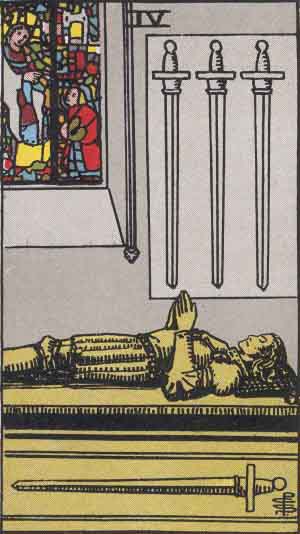
The Four of Swords means a break. Many of us are on enforced breaks right now, which can bring up a lot of Four-of-Swords-y Stuff. I have a ton of Stuff about the Four of Swords, because anxiety interacts with the concept of a “break” in weird, bad ways. Let’s take it in stages.
1. You shouldn’t take a break. Because what happens if you do? Tasks go undone, money isn’t made, obligations aren’t met. The world could start crumbling around your ears at any moment, and where were you when it happened? Plus, since you are at heart a lazy person (right?), any break has the potential to be the start of the rest of your life. Relax your vigilance, and you will simply sprawl out in bed with Netflix and never get up again. (When you are sprawled out in bed with Netflix, you better be telling yourself it’s Bad.)
But on the other hand, 2. You can’t take a break. Severe anxiety is constant. Once it claws its way into your bones, settles in at the back of your neck and in the pit of your stomach, it ain’t moving out. And being anxious all the time is hard, hard work. Your body is alert. Your brain thinks it’s gotta be ready to run away from an actual lion at any moment. You can sprawl out in bed all you want, but the cortisol isn’t just going to disappear from your system as a result.
So what do? I have not solved this yet, but I try for a balance. The Four is a meditative card. Meditation isn’t a break from your anxious thoughts, exactly, but it is a way to train yourself to notice them when they’re happening and be okay with them hanging around, which is a huge step towards being capable of genuine relaxation. Plus, sometimes you can trick your brain into thinking a break is okay if it’s a productive break, i.e., important mental health work. (Note: this is not sufficient. It is a trick to get you on the right path.) I like straight-up mindfulness and breathing-focused meditation, which feel very Four of Swords when I’m doing them, but I also love sunlight visualization (like the Kindness series on the Headspace app), and tonglen, Tibetan Buddhist compassion meditation (which I learned about from Pema Chödrön’s books; she does a guided session here).
But that’s still not a break. It can be – sometimes meditation is delightfully relaxing – but often it’s hard work, sometimes frustrating work. I do still think it’s a respite from the world at large, even if a particular session was quite difficult, but what if you really need a vacation where you don’t have to do anything? (As we all do! Sometimes!)
I’ve struggled with this a lot, because my hardworking brain thinks that I cannot help my anxiety by avoiding it. I am very susceptible to certain kinds of distractions – I’ll binge a show for twelve hours, read terrible fanfic until six in the morning, or sink into a video game and come up all, “What year is it??” This seems bad. It does not seem in line with our contemplative knight lying on an uncomfortable stone slab. I can watch myself turning away from good, useful work – whether professional, social, household, or therapeutic – towards one of these distractions, and I’m well in the habit of thinking, “This is bad, I shouldn’t be doing this, I’m bad for doing this, don’t click on the next video, don’t click don’t click don’t – fine, I guess I’m watching Part 142 of a relationship saga from a 2009 German soap opera after all. I’m the literal worst.”
So let’s return to list format to try and untangle all of that.
1. Sometimes you can’t. Sometimes the good, useful work is too hard, and you can’t. It took a long, painful, semi-chronic illness for me to really start learning this lesson: sometimes you’re just doing your best, and your best is lying on your couch watching German soap operas, because that is what you can do.
2. Yelling is counterproductive. If you want to do more stuff and not less stuff, telling yourself what a lazy jerk you are will not end to your benefit. If you can’t notice and honor your own need for a break – and notice and honor your own suffering if you have to keep going anyway – you’re stressing your system out. It’s okay to want to stop. It’s okay if you can’t do something. Even if there are going to be consequences. That might make things harder or less pleasant or different than you wanted later on, but that doesn’t mean it wasn’t okay to need a break.
3. Breaks help. This is not news, but it’s not at the forefront of my mind when I’m on Hour 107 of another Stardew Valley playthrough. But with anxiety in particular – avoidance happens for a reason. Your system is stressed out. If it’s bad enough to be constant, sometimes the all-out distractions are the only ways it can keep going, catch its breath and come back still tired, but able to take one more step forward. And if you can take the time, post-break, to go deep and be with that stress, those unhappy feelings, those unmet needs, then that can really help – but if you can’t, you can’t, and that’s okay. The break still helps.
So we need the Four of Swords. Both sides of it: the side where we close our eyes, breathe, and look at all the junk our brain has decided to spit out today, and the side where we say, “I gotta get out of here,” and go for a run, or to a party, or to the couch with our laptop, and take a break. But it can be a really hard card for some people, and if it that’s true for you, that’s okay.
 Minor Arcanas